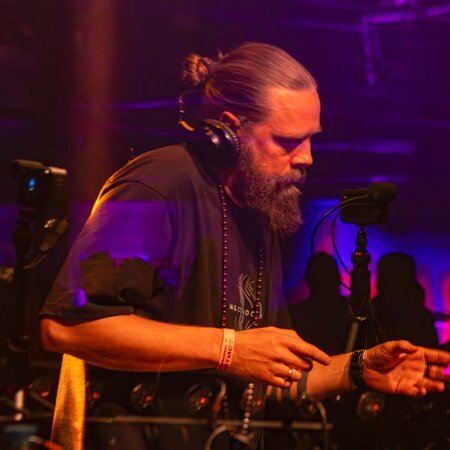
At the end of March, the 36th edition of the well-known NEUROPUNK podcast by DJ Bes and the TAMRECORDS label was released in Russia and beyond. With this edition, NEUROPUNK marked its tenth anniversary, having become a genuine phenomenon over the years—one without which the drum and bass scene is now impossible to imagine. So what is the secret behind the brand’s incredible popularity, and how was it achieved?
Speaking about NEUROPUNK, it is impossible not to mention its origins, its fathers—the collective of DJs and musicians who, after the success of the Saint Petersburg drum and bass dancefloor at one of the Kazantip festivals, decided to unite as the Total Advance Music team. Driven by their passion for music and enthusiasm, they went on to organize numerous parties in Saint Petersburg and began releasing their music by any means available at the time. Bes, Step, Key, Dissident, Ruffen—they laid the foundation for the entire story that followed. At the beginning of the 2000s, on the huge and flourishing global scene, the phrase “Russian drum and bass” sounded exotic, to say the least. The only flashes in this vacuum were releases by Paul B, Subwave and Dissident. So how did it happen that, just ten or so years later, the word neurofunk became associated with our musicians— Receptor, Engage, DaVIP, Encode, Kubrak and others?
The spark that kindled the future fire was a series of mixes in which DJ Bes brought together work by drum and bass producers from the post-Soviet space. The 78 RUS compilation took off unexpectedly even for its creator and sold tens of thousands of copies. There was still relatively little genuinely high-quality material from Russia at the time, but mainstream listeners were hooked by a familiar note—Russian vocals—in foreign and incomprehensible British music:) Riding the success of 78 RUS came the idea of releasing a series of mixes called NEUROPUNK—an amusing word that DJ Bes happened to notice on an internet forum. Resembling both the label’s main genre and Britain’s most insane subculture of the 1970s, it became both a symbol and a motto of the emerging movement.
In the mid-2000s, Russia was experiencing an internet boom. The many resources and forums where musicians could share experience, show off their achievements, gather information and make connections gave production standards a push forward. There was now enough worthwhile material for more than a single mix. In addition, the growth and accessibility of the internet drove the final nail into the coffin of the compact disc as a medium. The world came to be ruled by the MP3 format. Thanks to the spread of iPods, radio programmes that could be received by subscription—podcasts—gained popularity. Reaching listeners with music became much easier. A label releasing the most technologically advanced music could not stand aside from these new trends, and so the NEUROPUNK podcast was born.
The first few editions of the podcast had no voice-over. About once a quarter, DJ Bes collected tracks from all across the CIS, mixed them together and distributed them through forums and other scene resources. These mixes featured many new names, known within narrow producer circles but completely unfamiliar to the podcast’s broader audience. The idea was to take a microphone and tell people who these neuropunks were:) The idea worked! What is more, by talking about ordinary guys from small towns, DJ Bes gave hundreds of aspiring musicians motivation and planted belief in themselves. The patriotic notes in the podcasts and the competitive model became catalysts for an avalanche-like growth in the number of interesting producers and in the quality of the material. The podcast was noticed in the West, too. Releases by our musicians on the scene’s best labels became a regular occurrence. NEUROPUNK evolved from a series of mixes and a podcast into the driving force of Russia’s neurofunk scene.
As the number of musicians and listeners grew, so did the recording quality of the podcasts. Alongside excellent mixing, DJ Bes approached voice recording and the creative side of the project with the utmost responsibility. Its creator shared his recipes for recording a successful podcast in the article “A Million-Dollar Podcast”.
Like any cultural phenomenon, NEUROPUNK has accumulated numerous side projects. Alongside the regular podcast editions, retrospective instalments are released—the FAT, THE HEADSHOT and THE DEEPSPACE—divided according to their respective moods and collecting all the highlights of the past year. From time to time, editions of the SOULPUNK and ATMOPUNK podcasts are released; these are side projects featuring lighter drum and bass music. DJ Bes records special NEUROPUNK editions for friends—labels, promoters and online resources—in the breaks between podcast releases, so that his insatiable listeners do not break down his VKontakte wall:) One such NEUROPUNK SPECIAL was recorded for our resource, DropTheBass.ru.
The podcast’s huge army of listeners starts demanding the next edition the very day after the latest one is released. The loyalty of the NEUROPUNK podcast’s audience is unprecedented on the scene. The label’s releases are also eagerly awaited. It seemed that the label and podcast had enormous monetization potential, and that musicians would finally be able to earn a living doing what they loved while pleasing their listeners. However, the traditional Western model of selling digital releases proved completely ineffective in Russia. Taking into account the particularities of the music market in our country, the TAMRECORDS label introduced an innovative release-distribution model—the so-called “boost” system. It consists of distributing content entirely free of charge, while announcing a release several days in advance so that any listener can shorten the wait for its release by paying online by any convenient method. As a bonus, buyers receive the release in higher quality. In addition, this allows the audience to support its favourite musicians. Having successfully demonstrated itself as a way of selling TAMRECORDS releases, the system continued in the form of the resource Boostframe.com, where any digital content can be “boosted”.
Thus, over its ten years of existence, NEUROPUNK became not only a unique phenomenon on the drum and bass scene but also a genuine platform for new projects and the realization of ideas. What awaits the label and podcast in the future? What plans does its creator have? We asked him himself!
Tell us what you are working on now. How do you see the future of podcasts and the label?
The label and podcast workflows are set up and running like clockwork. I have not thought about any innovations for now because I am completely focused on Boostframe. After all, this resource will serve a broader range of creators, not only the drum and bass scene. When it comes to drum and bass, I sometimes feel that I have reached the highest possible level of development for the underground direction. Few people can boast a million-strong audience for a drum and bass internet podcast, or the fact that a festival fills venues with thousands of people for Russian names alone. No one has managed to achieve anything like that in the Russian EDM scene throughout its history. These words should not be taken as showing off or boasting, but as the dry results of a decade of work.
You planned to create a new label and leave TAMRECORDS as a springboard for newcomers. Are you still working in that direction?
With the arrival of Boostframe, I focused on enabling creators to release their work directly to listeners. Accordingly, opening a new label no longer makes sense. TAMRECORDS will remain a platform for newcomers, helping them build an audience so that, once it grows, they can go straight to Boostframe.
What releases are planned for TAMRECORDS? Will there be albums or compilations for the 10th anniversary? Are there plans to release physical media?
There definitely will not be any physical media; it is pointless. There will be albums and compilations, but there are no specifics yet.
Tell us about your Gydra project. How did the idea for the project arise? How do you divide the work within it? What are your release plans?
The project arose spontaneously. Mizo and Menfort found each other online after one of the podcasts, and they produced a very explosive and professional combination. To make things more effective, I offered to manage the project, and they gladly agreed to my management. I rarely participate as a musician on the tracks; I mainly advise on arrangements and groove, oversee the production as a whole, and handle the full range of directorial work involved in bringing the tracks they have developed to release.
Tell us about the Boostframe project. When will it leave beta? How, and how strictly, will creators and content be moderated?
The project is intended to solve a whole range of pressing problems for creative people: eliminate piracy, forget the hassle of dealing with publishers, and give their muse directly to people. The key word is “give”—honestly. After all, creativity is free. The only thing that costs money is the time spent turning that creativity into finished content. And the audience compensates for precisely that time with an arbitrary donation, shortening the timer. We plan to leave beta in the autumn, once the worldwide English-language version has also been implemented, with payment tools for boosters from anywhere in the world. We plan to moderate strictly: we will check the content itself, investigate the creator’s public significance, and talk to them on Skype for video identification. At the beta stage, I am currently admitting mostly people I know.
A few personal questions. How much of your life do the label, the podcast and everything around it occupy? What are they to you—a hobby, a job, or all of the above? Do you still get as much pleasure from what you do as you did ten years ago?
It is simple: this is a full-time job that grew out of a hobby over the years. I am tired only of travelling on tour; otherwise, all the activity and public work give me genuine pleasure.
Are you interested in other bass music besides drum and bass? What do you love about drum and bass apart from neurofunk?
I generally love all well-made music. I listen to drum and bass only for work. The rest of the time, in the background and in the car, I listen to anything that is not heavy—mostly chillout.
And finally: when is the next podcast?:D
Two to three days after the announcement on tamrecords.ru:)