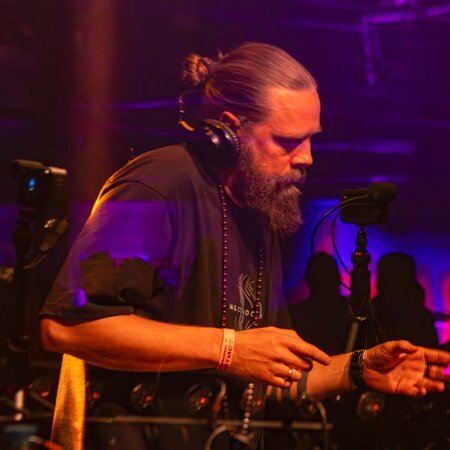
Ahead of the SPBDNB Awards 2004, which take place on 19 March at Zanevsky Cascade, we spoke to the leading contender for Best Producer: Dissident, musician and co-owner of the label Total Advance Music.
Let's start by talking about you. How did you come to drum and bass, and what were you into before that?
At first it was techno and, perhaps, trip-hop. Lots of different music. But in the end it was drum and bass after all. From early childhood I used to walk around and do this: Doof-doof-tyf-doo-koo-doo-koo-doof-tych... (beatboxing). I didn't understand what it was; I just liked it. Then, when I was old enough to understand, I heard similar rhythmic patterns on a cassette one day and realized: this is mine!
Did you beatbox?
Yes! In fact, I can still do it now, and at very high speed, so that everyone is amazed. It's one of my signature routines.
Did you ever go to your first drum and bass party? Which club was it?
I don't remember which party it was... I think it was the same old “Mama”... It was around 1997...
What was the first drum and bass you heard?
Someone gave me a cassette; it was still jungle. Back then there wasn't even the concept of drum and bass, at least nobody used the term widely. It was a pirate cassette of some German release. I don't remember exactly what was on it... Johnny Jungle, also known as Pascal, and things like that. Then the “Mama” club opened, in 1997 or 1998, and everyone went there. The whole early scene was there.
When did you decide to try writing something yourself? Was it at home on a computer?
No. For some reason, people had a very strange attitude toward computers. Back then, Andrey Aspekt and I played all kinds of punk outpourings and guitar hardcore... I wouldn't say I liked it that much, but I really wanted to make music. At the same time I had this device—a Roland PSR-5, a tone generator and sampler. I made some things on it. Then I bought a Yamaha DX-27 synthesizer and a Polivoks. For some reason I took a hard line that computers shouldn't be used, and that you should use hardware and play it. The computer came later, when I really understood that everything was much easier with it; that was around 1999... Programs such as Cakewalk and Cubase were popular then. That's where I started.
I started in FastTracker myself. It was a powerful thing! =)
I know Bes started in FastTracker. I never even picked it up, because that program is a complete madhouse, in my opinion.
So, the interesting thing was that because of such a hard-line position on computers, we somehow managed to make things without them—sometimes even rather interesting things. When music is created in real time, it always relies on improvisation. And improvisation is always a direct outpouring of a state of mind. In other words, it is more performance than composition.
How did Dissident come about?
I've always been Dissident; that nickname dates back to very, very long ago. I came up with it myself, and that's what people called me.
And when did you first get behind the decks?
I got behind the decks relatively late, only about four years ago. We mainly performed live. I remember my first performance was in 1999 at Griboedov club. At the time we were called “Creative STEP Collective” (one track, “Hello, Louis!”, appeared on the first or second Respect compilation). Of course, I didn't come up with that name; MC Akim did. Eventually we changed our name to Dissonance. There were four of us—Lobzik, Aspekt, Akim, and me. Lobzik is Nec now. We always performed live, and sometimes it looked rather funny. I remember parties at Klim Voroshilov club: we brought all our synthesizers, drum machines, mixers, computers... In short, a huge amount of stuff, and we carried it all on our backs, on the metro, then through −20°C weather... Pure altruism! Once we were performing and practically nobody came to the party. There were only the organizers and one little girl of about four. She jumped, spun around, and rolled head over heels to the sound of us playing the hardest darkside on a pile of hardware. I still don't really consider myself a DJ; I always insist that I'm a producer first and foremost.
What did Dissonance write?
We wrote techstep. Extremely hard stuff, even with elements of gabba and hardcore. There were amens too, of course—how could there not be? It was simply hard, very dark music. There was even more darkside than techstep in it.
When did you start creating separately?
A situation occurred that happens quite often in groups. First, there were ideological differences—not serious ones—and second, I wrote a lot of music on my own. I don't want to sound immodest, but the fact remains: I won't be afraid to say that 70 percent came exclusively from me, and I thought I had to move forward on my own. For example, Dissonance has an album called Technical crisis (by the way, it turned out very well and received many positive reviews). The album came out on Manchester Files, and I wrote 80 percent of the material. Then we calmly got together and I explained the situation. I said, “Guys, either you start moving your asses, or we'll split up for a while.” So we split up, and so far we still haven't reunited. Nec writes solo, Akim is working on his hip-hop project, and only Andrey Aspekt and I still sometimes write together—but not drum and bass anymore.
How did Total Advance Music come about?
Bes, Step, and I went to Kazantip together one time. It was in 2001. We lived and hung out together, talked a lot about near-musical subjects, and that's where the idea was born and the ideological framework was created. T.A.M. was not originally conceived as a label; we simply wanted to organize parties, but then it naturally turned into a record company. We began releasing a lot of music. Now we focus more on publishing than on organizing events.
Let's talk about your tracks. What style are you following in your compositions at the moment?
I change styles all the time, but lately I've lightened up a lot, because I no longer have the patience to keep writing heavy music. At the moment I'm a little tired. Dissonance existed for about three years; I've been writing alone for three years now. All that time I tried in some way to address the dancefloor. Today I try to write music that is more pleasant to listen to at home or in a small club than at big raves. Naturally, dancefloor tracks do appear sometimes, but lately I've been turning more toward a deeper atmosphere. Less liquid funk; I sometimes write it with Ruffen, although that kind of music now seems a little “soapy” to me. We played it for a while, but I think it is better suited to McDonald's and similar establishments, where people eat and need something positive and unobtrusive so the food doesn't get stuck in their throats. In other words, music for the stomach.
For a while I was heavily into neurofunk. Neurofunk is the so-called “talking bass” or “woodworm” bass. In other words, the bass in the mid and high frequencies changes its filtering. It may not even change pitch, but the filters, modulations, and effects applied to it are constantly changing. This creates the effect of a “talking” bass—that is, when the bass is trying to tell you something.
In some alien language? =)
Yes! =)
For example, as in your track “Stigmata”?
Yes, quite. Incidentally, Stigmata has been unable to come out for almost two years now. Paul B is planning to finally release it as the third release on his Step2Zero... possibly. My work is already very different now from Stigmata. I have a lot of signed tracks on different labels, but their release is constantly delayed for one reason or another. I think that by the time all of this finally comes out, I'll already be writing completely different music. This happens often, with any musician. A track being released two years after it was written is hardly a new story. The public simply doesn't know this and takes it at face value as a new release.
So a track remains a dub for two years?
Yes. Recently the concept of a dubplate has become so relevant because many musicians upload full versions of their tracks to the internet in good quality. Many people start playing them, many people find out about them, and the tracks become hits even before they are released. But by and large this directly harms the musician—for example, I've suffered from it. Labels simply cancel a release because they see that nobody will buy it, since everyone already has it anyway. Nevertheless, I still upload tracks in good quality, because I stopped chasing labels with my former fervor a long time ago.
How many labels have you released on?
By this point, just three records. They came out on Renegade Hardware, Fear Red, and the Finnish MangoFunk. A track called “Space Rider,” also written two years ago, came out on the latter quite recently. I've stopped talking altogether about the tracks I've signed to various labels; there really are a lot of them. I've signed practically all my music. But until it comes out, I won't talk about it, because what happens is that either labels go bust or owners refuse to release the track because everyone already has it. It's a kind of superstition. In general, the vinyl business is going through a severe crisis at the moment. The thing is, practically nobody except DJs needs vinyl. Selling more than a thousand copies is very difficult. I think the future belongs to MP 3. In another five years, records will no longer be sold through open retail at all, and only promos will be sent out.
I think this crisis has dragged on for quite a while, especially here.
Naturally. We don't have a vinyl business here at all. Russia would have opened some vinyl label long ago, even if only for the domestic market, but nobody has turntables to buy records. Nobody needs it. You could even get worldwide distribution. But you would have to release music that was one hundred percent certain to sell. We already have an example: Paul B opened his Step2Zero and has already released two records. But he always looks for compositions with the broadest possible appeal. They may not be bad tracks, but the real diamonds, as a rule, are not understood by everyone. And the best drum and bass music always remains on dusty shelves belonging to people who are genuinely interested in it. For example, the intelligent scene is enormous: huge numbers of musicians and huge numbers of labels. But these labels can't find distributors because intelligent music sells terribly on vinyl, since there aren't many parties and so on. Roughly speaking, it isn't entirely dance music; it's music for listening at home. We also have producers working in this vein, such as Electrosoul System, Intersidereal, Uzhas, Cryo, and Subwave. Many people around the world know them, but it is very difficult for them to release this kind of music.
So does that make it a kind of underground within drum and bass?
Naturally. That's how it turns out: it's underground. In any music, whatever is less accessible to the majority is what sells worse. I believe intelligent and atmospheric (let's call it leftfield, meaning “left” or “left-polar”) will survive; it is the best part of drum and bass, its very soul and heart, its alternative. It will simply exist on other formats, on CD for example. CDs have already begun to be released actively. Since this is music for listening to at home, it should ultimately be more available on CD.
There is also a second problem for a Russian musician that prevents them from being released abroad. They may write wonderful music in every respect. But, say, they speak English poorly and cannot properly negotiate with label owners. Or they have no permanent internet access and cannot “stew in” this “mush.” And in general, it is always easier to do business and negotiate in person—to meet people. That is difficult to do in Russia when you are sitting somewhere out in the middle of nowhere. And again, not all labels will listen to the MP3s you send them; they will ask you to send a disc. I have never sent discs anywhere because, first, for some reason I'm always too lazy, and second, they don't always arrive. Apparently our valiant postal service keeps the discs for itself and listens to them. I get it! All the dub traders online are postmen. =)
What do you pay the most attention to when writing tracks? What do you emphasize?
Back when we played hardcore, I played bass guitar, and until very recently I always paid more attention to the bass and its various variations. I synthesized it on different synthesizers, experimented with it in every way, and put the emphasis on it. Today I'm slightly tired of that, and I've started paying more attention to the drums and their breaks. For example, Paradox interests me a lot in this respect, as does the so-called drumfunk scene—Fracture & Neptune, Fanu, Macc, old Photek.
I always try to pay attention to sound quality—that's one thing—and, two, to making sure the music isn't boring, so that you can put on a track and remain interested from beginning to end. I prefer intelligent music, because it should provoke a certain thought process—not merely sitting in a chair scratching your stomach or shaking parts of your body on the dancefloor, but making your head work too: comparing, analyzing, and drawing conclusions.
So—intelligent drum and bass?
Yes.
Previously, the drums in my tracks emphasized the bass; now the bass emphasizes the drums. In general, if you are making a techno sound, the drums naturally have to be minimalist. Many people don't understand techno sound because they think it is looped and monotonous. What do you mean, looped and constantly repetitive?! Music is a reflection of life, a reflection of emotions. Every day you leave your house and close the door; every day you see the same landscape; every day you come home, sit in your chair, and see the screen of the same computer in front of you. Everything is looped! Why can't music be looped?!
And when you write a track with someone else, who creates the original foundation, and who finishes it afterward?
As a rule, when I write with someone, the idea starts with me, because I'm very creative in that respect. I write a lot, and sometimes I don't have the time or energy to finish everything. Practically all the tracks written with someone else are initially some of my own sketches, and then we either finish them together or the other person finishes them alone. That's how I have worked, and still work, with Ruffen. Lately we've been focusing on remixes. In particular, we made a remix of Resound, and we're making a remix for the group Kasta. We'll finish this material soon, and I think it will be interesting.
Will it be several remixes of their compositions?
We've started with just one for now. Possibly more; they became interested themselves and suggested it to us, and we didn't turn them down. In general, I can single out Ruffen as a good remixer. I absolutely can't make remixes, because I always have a heap of my own ideas and I drown in them! Sometimes I simply can't sort through them. I often don't have enough time. Sometimes I really like a track and ask for it to remix. In the end I realize that I can't make it better, while making it worse simply makes no sense.
How often are you asked to make remixes for someone?
Quite often. But again, I can't cope with the task; I have very few remixes.
Now I'll ask you a broad question: What is drum and bass to you? Is there such a thing as drum and bass culture for you?
If we are talking about drum and bass music, I can't say that I listen to and write exclusively that. I simply know that it is what I do best. This music is filled with a certain energy, absorbs absolutely any genre, and is self-sufficient. So, as a rule, I write drum and bass.
As for drum and bass culture, it exists in principle. For example, in Eastern Europe—in Hungary, Slovakia, and other countries—drum and bass exists as a way of life. It can involve particular clothing and perhaps a particular culture of speech. We don't have that, simply because none of the people involved in drum and bass culture in Russia fully understands all this. And I myself can't boast that I am completely part of the drum and bass culture that exists throughout the world. So it is very difficult to characterize drum and bass culture clearly. Ultimately, it is above all a musical direction, a genre of electronic music.
Do you think drum and bass is just music and nothing more?
Of course not. Drum and bass has one particular feature: it is a self-sufficient system. You can identify certain elements in drum and bass that are present in every track. There is the high speed, and the emphasis on percussion and bass lines. That's why it is called drum and bass: because it is drums and bass. But those drums and bass can be emphasized in any music, whether jazz, house, hip-hop, or anything else. Anything can be laid over drum and bass. Accordingly, it is worth more, because here you can hear anything your soul desires, anything that suits your mood at the moment.
And do you think it is fair to say that drum and bass has become “pop” here in Russia?
I don't think so. “Pop” still means popularity. Let's compare the popularity of drum and bass with the popularity of Star Factory... The comparison is impossible, so you can't talk about it becoming “pop” here. But there is another question. Many musicians and DJs try to play accessible music for the masses so that it will become popular. In other words, many strive to make drum and bass go “pop.” These tendencies are perfectly understandable: people want to earn money and reach a larger audience. This applies to practically everything. It is show business. Pop is what is sold in large quantities and fills huge venues. We have the festivals Pirate Station and The World of Drum’n’Bass, and the entire Yubileyny Sports Palace is packed with people, but you still can't call drum and bass “pop.”
That's the main thing I wanted to hear from you. But not everyone goes to such large events for the music...
Yes, many go there to take something. As a rule, I think more than half go precisely for that—to get pleasure not from the music but from the state they are in while the music is playing. But you can't say that about Pirate Station alone. Club culture has stood on this foundation since time immemorial. I sometimes play in the morning, at six or five. People who are, for example, under the influence of amphetamines practically don't care what is playing at that moment. I can afford to play absolutely insane experimental tracks, watch the no less insane reaction of the crowd, and realize how much the consciousness of an irrational person degenerates when they are under the influence of drugs. I remember playing at Tunnel club at around seven in the morning; I specifically asked for that time. Techno was playing before me, and people were making monotonous movements at 140 beats per minute. I put on drum and bass, and they simply sped up their movements to 180. That's all.
That was a pretty hardcore joke! =)
Yes, nobody left the dancefloor! =)
I wanted to talk to you about the concept of “clownstep.” What is it?
Clownstep is a fairly abstract concept. I don't remember who introduced it first. John B even had a label called “Clownstep.” In fact, it is an ironic, generic term. This music resembles some kind of circus flourish. The bass comes on the offbeat, as in pumping house, which people in Russia also like to call progressive house, and you get “Ootz-ootz-ootz-ootz,” so you can perform funny movements to it. This music is completely devoid of any thought; it is simply intended to make your butt shake. =) Sometimes hints of clownstep even appear in the work of the respected Fresh, and Pendulum as well. Despite making very high-quality music, they still allow themselves some circus excesses. In reality, there is no genre called “clownstep,” so it should not be taken seriously.
How do you assess the Russian drum and bass scene in relation to the global one? How developed is it?
Naturally, in relation to the global scene it is rather underdeveloped. There is a phenomenon in Russia: a great many people try to write this music. And that's good! The other issue is that people simply don't realize that their music is not yet worthy of broad attention. I am given a lot of demo discs, and sometimes I am simply astonished! Very often people cannot objectively assess their own work. There is sheer madness on some of these discs! But I'm one thing; Kostya Gvozd receives an enormous number of discs and MP3s, and he tries to listen to everything because he has a radio show and needs material. He also very often complains that he comes across complete fucking shit.
Actually, things aren't that bad. We have quite a lot of talented people who know what they are doing and have decent taste. The other issue is that people who do more than simply write or play drum and bass are important; you can't get far with musicians and DJs alone. We urgently need critics who can write about it intelligently, and listeners who understand it matter too. Not just people who have succumbed to fashion and, on hearing amens, say that this is real drum and bass. There should be shops specializing in this music. There should be various information resources so that people can get information about the scene.
There are several promotion groups in our city. Which of them seem most promising to you?
Thank God, there are now fewer young people who imagine that you can make a lot of money organizing parties. For a while they were springing up like mushrooms. Many—I won't name names—lost huge amounts of money and stopped doing it. To organize parties properly, you need enormous experience. Today, as a rule, the people putting on worthwhile parties are those who have been doing it for a long time. It is difficult to organize a noticeable party today without inviting foreign artists, and that involves enormous expense. And in principle, that no longer surprises anyone. Nobody wants to organize a party in advance with the expectation of merely breaking even. Those who genuinely know how to do it continue their work.
So it isn't always profitable to bring over a star, expecting a large crowd?
What does “star” mean? In Russia, you can make someone into a star very easily, actually. Some of our club audience knows no more than a dozen names. Previously, it was enough for many people simply to hear that someone had come from England, and they would bite. Today it has to be a genuinely established name. And how can you establish that name? You can mention it frequently on the radio, put it in tracklists, or organize a huge PR campaign on the internet. Our audience is so unprepared that a star can be created artificially. The other point is that I'm not talking specifically about stars; I'm talking about foreigners. It gives me great pleasure that Seba, Nookie, Resound, and others have performed in Russia. But who knows Resound?! He is still a fairly unknown fellow, but he writes wonderful music.
I've noticed that it is difficult to find a worthy foreign artist in our music shops. We sell records by Bes, Gvozd, Davila, Toper, and so on... I encountered a situation where someone did not know that a disc with a Gvozd mix contained no tracks by Gvozd himself... People know our St. Petersburg musicians because their records are sold here. Why is that?
An eternally relevant question. This really does happen here. People think DJs write the music they play. But that is complete idiocy, of course; I've encountered it many times too. Many people are still convinced that there is no musician in Russia cooler than Boomer, although I have never heard a single work by him. It is madness. Many justified this by saying that one record has the bass and another has the drums... What can you say about drum and bass culture after that?! What is the point of creating this culture if people don't even understand elementary things?! This happens because, first, club culture arrived late in Russia—about six years late. And there is not a sufficient information field; people have nowhere to learn things. They can buy a CD, listen to the music, and know what it is called. But what stands behind it, the elements of the scene, is completely unknown to people and, as a rule, uninteresting. There are food gourmets, for example, who know how and what is prepared, where a particular ingredient comes from, and which cuisine and country is preferable... The same comparison can be made with music. For many people, fried potatoes and dumplings are enough, and they don't care what they are made of. They can go to McDonald's and get as much pleasure as from refined, expensive cuisine. And you can understand them; you can't condemn them for it. They simply aren't interested. For them, music is just food for the ears, not for the mind.
In my view, that is very sad. Who can be blamed for it?
Let's move to another level and take the pop-music scene as an example. Compare foreign pop music with Russian pop music. Let's compare Kylie Minogue and Masha Rasputina, for example. Can these two artists really be compared?! The most interesting thing is that gloomy, hunched men sit in studios and sculpt all that music for talentless girls who have seen a microphone three times in their lives, then become stars and are loved only for their tits. These men can make things well, but the producers and sponsors of these female and male singers frankly think, “Why make it good if nobody will understand it and it won't sell?” Making it good requires studio time, and our producers are rather greedy people who don't want to spend money on it. Who can we blame for all this? The situation in Russia as a whole is to blame. It affects every aspect, whether underground culture or the mainstream. The situation is exactly the same in the visual arts. There are huge numbers of talented artists in St. Petersburg. But nobody here knows them because their paintings are exhibited and bought only abroad. It is the same in drum and bass. Many musicians focus exclusively on the Western scene. They simply don't care what is happening here. I followed the same policy for a while. But then I concluded that we have to educate our audience somehow, release albums here, and try to orient ourselves toward our listeners.
Can you point to any changes in the scene over the past year? Has anything changed for better or worse?
First of all, drum and bass has acquired a flavor of ordinariness. In other words, it is no longer some new genre for our listener, a genre that looks to the future and represents an avant-garde direction. In 1997, for example, we were simply proud to be connected with something completely unexplored, something only just emerging that needed to be pushed and pushed... Now, in my opinion, everything that can be done has been done. Everything is proceeding in its own course. Some people are trying to make money from drum and bass; others want to appeal to everyone. Overall, it is difficult to say whether the drum and bass scene has changed for better or worse. The general trend cannot make you happy or sad. We know that the scene has settled into place by now. It exists, it has taken up clear positions, you can name the people involved, and you can find your way around it.
How would you assess the situation with clubs? Which of our clubs is best for holding drum and bass parties? How would you characterize the audience at drum and bass parties?
I don't attend only drum and bass parties. In fact, I feel more comfortable at a party where lounge or house is played, because I think house is best for dancing. If a club is genuinely good, has had a lot of money invested in it, and has good DJs playing, then it shapes its policy around attracting wealthy people. And who are wealthy people here? Usually spoiled youngsters who have achieved nothing on their own, whose parents have provided them with jobs, bought them a car, and bought them a lot of clothes. They go to clubs simply to show themselves off. At Par I noticed how people's faces changed as soon as they crossed the club entrance. The concept of “pretension,” and of “rotten pretension,” is revealed precisely in these establishments, even though I like them best in terms of music and policy. If I want to relax, I won't go to a drum and bass party, because drum and bass is embedded in every molecule of my body. I know this music in complete detail; I can break it down into all its parts. So if this music is also playing when I'm trying to relax, it distracts me a little. I mainly go to drum and bass parties when I'm performing there. But since I have quite a lot of performances these days, I go to other places less and less often.
It is difficult to name the best club for drum and bass. There is an opinion that drum and bass is music for young people. You can see a certain logic in that, because the mainstream in drum and bass is energetic, loud, and fast—exactly what a young maximalist needs. And this audience recognizes nothing except Pendulum or Dillinja, say. Such an audience really exists. I don't feel entirely comfortable onstage when I realize that the audience is not yet ready for what I can give them. So it is difficult for me to name a place where these people should go. It seems to me that events such as Pirate Station are exactly what they need. Drum and bass parties can be held anywhere. But for now, this psychologically immature youth has no place in respectable establishments. Many people who listened to drum and bass in the 1990s now go to “posh” clubs and listen to drum and bass quietly at home, because they don't want to be next to underage hooligans. There should be parties with atmospheric music, and a thoughtful audience should be attracted to them. In that respect I really liked the Listen'Up! parties at Griboedov club. The audience there is far from perfect too, but at least I can see that interested people come, people who understand what is being played. In other words, small private parties in small clubs are the answer. Mass events existed, exist, and will continue to exist, so let the listeners grow in awareness.
Oh, I got carried away a bit. Don't think I have such contempt for the audience—no way...
And what do you think our clubs are lacking?
Our clubs lack decent sound. That is a major problem. Parties are often held at the Red Club now. Thank God, they have managed to get the sound system working reasonably well. Before, it was simply insane. There is decent sound in expensive clubs, but it is impossible to hold a drum and bass party there because people simply cannot afford to go.
Every year we have an all-Russian drum and bass convention organized by Respect Family. What does it offer, in your view?
What discourages me slightly is that all the convention participants are supposed to gather and discuss pressing issues before the event, but that does not happen. To create that kind of exchange of information, it is necessary to build a discourse around it and let it develop. The problem areas need to be identified, and some kind of dialogue needs to be established. But it doesn't work because people are embarrassed to say anything, or simply have nothing to say, and see nothing beyond the music. Nevertheless, this event naturally is useful.
Once DJ Boomer expressed a negative opinion about the convention—namely, that what happens at the convention has nothing to do with the concept of a convention.
It is clear why he says that. He has taken a very hard line. He believes that since he started this whole thing in our city, he alone has the right to be in this business. He thinks organizing parties is his business alone, and that everyone else is taking it away from him. It seems absurd to me, because competition must exist. I absolutely do not want to detract in any way from this man's achievements. He really was a pioneer here in our country. But his opposition to everything that happens sometimes simply has no justification. He gives the impression of someone who has been toppled from a pedestal and cannot come to terms with it. DJ Boomer has remarkable charisma. He dresses well, plays music suited to people on the dancefloor, and is the oldest and best-known DJ. People like him, and as a DJ he is very good. But his firm hostile position gives me cause for concern. By the way, I heard that he wants to become president. Well then—go for it!
Let's talk about Total Advance Music. What is happening at T.A.M. now?
Everything is proceeding as usual: we are releasing compilations and albums. We are more involved in publishing, but we have not stopped organizing parties with foreign guests. We have taken a particular position. T.A.M. is, above all, a community of musicians, and this community has become well established.
Can a young musician get onto T.A.M. releases?
Of course. Naturally, we conscientiously listen to the demo material submitted by young musicians. To appear on our compilations, you must first and foremost make high-quality music. If you have written a track that is very good musically but is not mixed well enough or is poorly arranged, we will keep that musician in mind and always offer advice, but we will not release that track. We are extremely demanding in our selection of material. Respect Family, for example, tries to promote young musicians and give them a chance. We, on the other hand, try to present current drum and bass at its cream of the crop.
As someone with drum and bass in every molecule, what can you wish our website, SPBDNB.RU?
I supported the creation of a site like this from the very beginning. I can advise you to moderate your forum more carefully.
I used to be a very active participant in various conferences, back in the days of the first version of drum’n’bass sector. But then I got tired of swimming in human idiocy. I realized that it was pointless to prove anything to people, and that wasting time on it was pointless too. Moderators need to work more confidently and delete all this filth. You need to expand the descriptive section. At the very least, express some opinions so that people can fill the particular information gap that exists. More articles and interviews. It would also be good if your online shop could send discs abroad. Foreigners often ask me, “How can I buy your album?” and I answer that for now they can't.
Finally, tell us about your activities and interests unrelated to drum and bass.
My profession is sound engineering. I work as a sound operator at Lenfilm and on Channel “Petersburg 5.” I am partly involved in film production.
As far as I know, you are writing music for an upcoming film.
I have written music for two films, and I am involved in that now as well. But it is quite difficult for me, because I have a very narrow view of what is happening on screen. It is difficult to find common ground with a director, because millions will watch the film, and not everyone will understand what I am trying to convey. Working as a composer is unusual for me, but I have some experience in it.
Apart from work, I am very interested in various aspects of culture. I am a great admirer of the visual arts and philosophy, particularly the Moscow Conceptualist school. That is one of my interests. Literature is my first passion. I could talk about it and name authors for days. I write myself too, but I have not tried publishing yet; I am still practicing.
In general, I am a versatile person. I highly value “omnivorousness” in people. You should be able to take in different genres of music, completely different literature, and other manifestations of human creative activity with ease. You should assess objectively whatever you perceive. You cannot set rigid boundaries for yourself. You cannot say, “I like drum and bass, and everything connected with house is alien to me!” You must always pay attention to everything. Life is diverse and full of secrets. If you move along a narrow corridor, you will never understand anything. I think it is good to be deeply and fanatically engaged. For example, I was not originally in love with music as such. I am in love with sounds. I am also in love with text. I enjoy perceiving text and sound. It is hard work to perceive art. You need to read, listen, and watch a great deal to remain well-adjusted and not fall out of the cultural context.
Interview: Bass_Infection.