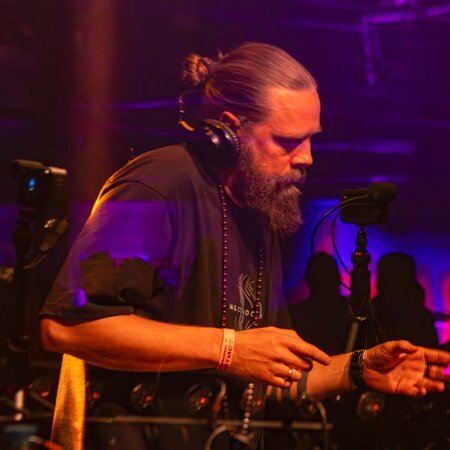
Bass_Infection: Tell us a little about yourself. How did you become a DJ?
Gvozd': There was a period in my life when I really wanted to express myself as a musician, but for some reason I thought—probably because of youthful stupidity—that it was too late for me to try to get onstage with an instrument like a guitar, for example, or something else, since at that time I was listening to punk rock and guitar hardcore... I had to come up with something new. It just so happened that I gradually started listening to drum and bass, and electronic culture in general was something completely new to me... I thought, “Yeah, cool! Maybe I can express myself through this somehow...” My first records, all of which carried a darkside mood, were an alternative to punk rock for me. Basically, I expressed myself as a punk-rock person on the electronic scene. At first I played in a store. There was a time when I had no idea what a DJ was supposed to do, and it seemed really cool to me when people ran off the dancefloor. I thought, yeah, the ideal was to make people run off the dancefloor. I tried to play music that would make people run off the dancefloor. =)
Bass_Infection: Before drum and bass, were you into punk rock?
Gvozd': More specifically, hardcore. Punk hardcore—that is, guitar hardcore. Punk rock passed quickly. I didn’t like a lot of things about that music. First of all, I didn’t like how slow it was; I needed more aggressive and faster songs. Although I had a punk concept in my head, I moved among hardcore musicians.
Bass_Infection: Did you listen to the Sex Pistols?
Gvozd': Of course I did. The Sex Pistols and the Exploited. But they’re all sellouts. I’ll put it this way: Wattie, the Exploited vocalist, absolutely doesn’t give a damn that he’s a commercial figure and that he’s known all over the world. He simply does his thing, and does it properly. The Sex Pistols also didn’t care that they had become popular stars. They were just messing with everyone. But strangely enough, in the end they turned out to be sellable show-business figures. I’m not very interested in them because of their commercialism. There are many other bands.
Bass_Infection: Did you study turntablism anywhere?
Gvozd': No. I went to parties and watched what the DJs did... I practised alone a few times... Once in my life, someone showed me roughly what needed to be done. That’s all.
Bass_Infection: So you’re self-taught?
Gvozd': Yes.
Bass_Infection: How did you get onto “Record,” and how did you become a presenter?
Gvozd': It was another sudden impulse. These things are generally inexplicable when you do something. At a certain point you realise that you have to do “it.” Either you do “it,” and then “it” works out, or you don’t do “it,” and then “it” may never happen at all. I thought you could only get onto “Record” with sponsors. The sponsors backed out after they were given the monthly price list for the programme. I called “Record.” It turned out that people I vaguely knew had taken positions as programme director and another “official” at the radio station. I called and said, “This is the situation: the sponsors backed out, so I guess it’s not meant to be for me to work with you...” They told me, “No, don’t worry about it—we’ll find sponsors for you, it’s nothing. Come in and record a pilot episode.” So I recorded a pilot episode. They said, “Standard stuff; we’re not interested.” The pilot included stories about various Western people and Russian people, the music, a chart... That was roughly how I outlined the programme’s script at the time. But they offered me, “Why don’t you host a progressive house programme?” I replied, “No, let’s not. And if I do, I’ll use the name written in my passport.” I didn’t want to put the name “Gvozd'” on display in that programme. But in the end everything worked out better. Together we came up with the concept for the “Dijoystick” programme, which at least covered the entire underground scene. I immediately excluded progressive house and commercial trance from it and began reviewing the alternative that everyone loves. Gradually everything came together around “Pirate Station.” There was a period when there was no drum and bass music on “Record” at all. I literally had to keep smashing my head against the wall, smashing it... Now people treat “Pirate Station” well...
Bass_Infection: How long ago did you realise that drum and bass was your music?
Gvozd': Probably even before I bought my first record. Although, strangely enough, without knowing what drum and bass was really about, I thought I could bring a new perspective to drum and bass—something midway between techno and drum and bass, techstep, roughly speaking... I didn’t know there was such a style as techstep. I thought you could mix techno and drum and bass and, through that, present a new development in music. I bought my first record in techno, with a four-to-the-floor kick.
Bass_Infection: What was that record called?
Gvozd': It was something on the Chain Reaction label... or perhaps a producer. It was minimal techno...
Bass_Infection: What was your first drum and bass record?
Gvozd': A “NeoTech” project on the “Moving Shadow” label.
Bass_Infection: Have you tried composing tracks yourself?
Gvozd': Yes, I have. My track, in a remix by Dissident, was played a number of times by DJ Krush and Psidream on their drum and bass radio show. That’s basically my entire achievement in the world of production.
Bass_Infection: In your opinion, did the track work?
Gvozd': Actually, the original wasn’t finished, to be honest. =) In this case I’m the creator, musician and producer. Whether it worked or not isn’t for me to judge. At the same time, I lean towards the position that if someone is sincerely engaged in this work, you can’t say that the track didn’t work. Maybe that person simply feels music that way and writes it that way. They don’t see it differently; that is exactly how they see it. But in this case, of course, we’re talking about people who have acquired some technical knowledge. If a musician is at the beginning of their musical path, it’s immediately obvious that they’re still experimenting and everything is still raw, because they don’t yet know certain techniques. I wouldn’t say that I’ve achieved a high level of technical mastery. But I’ve definitely achieved something...
Bass_Infection: Can you say what you used to write your track? If it’s not a secret, of course...
Gvozd': No, it’s not a secret. The main programme where all the samples were arranged was FruityLoops (a lot of musicians aren’t ashamed to use that programme). Everything else—where the samples came from and where they were processed—can remain everyone’s private business.
Bass_Infection: In the future, do you plan to continue your solo DJ career, or might you try working together with some group?
Gvozd': First of all, we’ll see what comes of my music. Secondly, some interesting things might come out of working with an MC. But it’s too early to talk about that. I’m still at the very beginning of this path. However, the person I was close to during my punk youth has now suggested that I sing and rap over drum and bass as an MC. Strangely enough, everyone from that period whom I meet actively listens to drum and bass. Apparently I was right in choosing my music back then—in other words, those circles have made it to drum and bass. At least, drum and bass interests them more than any other electronic music. So, this person has already been onstage for years and has released more than one album. His vocal ability and reading speed are both fine. I think it could turn out to be very interesting. I’d also like to try working with some musicians in the studio. But I haven’t set myself a specific goal yet; I haven’t looked seriously for vocalists with whom I could work for life. They need to understand that there will be many obstacles along the way that push you back and have to be overcome. In other words, you must not fixate on constantly making money from it. To start making money, you have to work very, very hard. But I’m afraid I’ll have trouble finding such people, especially people with vocal talent, so for now I’m not rushing into anything... The time will come when it comes. =)
Bass_Infection: Tell us a little about “Respect Rec”: what has been released on it, what are the plans for the future, and who is in charge?
Gvozd': “Respect Rec” is one area of Respect Family’s activity. It’s considered that I’m in charge, since I came up with everything. =) “Respect Rec” is a label that so far—from the beginning until now—has produced releases only on audio cassettes, that long-forgotten club format. Everyone has moved to CDs; we’ll be moving to CDs soon as well. Of course, we’re not talking about vinyl yet, but work in that direction is under way. Let’s put it this way: information is being gathered, connections are being established, and before you know it, the first vinyl release may not be far off. There have been around fourteen releases; I don’t remember exactly, perhaps fewer, but no more =). There were several “Respect” compilations with various St Petersburg drum and bass musicians, not only those belonging to Respect Family. There was also a compilation called “Drum and Bass Convention” with various musicians. Then there were several mixes by interesting people, including DJ Drummer—the most authoritative atmospheric figure in Russia. More precisely, one of the two most authoritative atmospheric figures in Russia. He has all the NewSchool Atmospherica releases, fantastic mixes and selection. We released him on cassette, for now... Since we know the cassette market, this same mix may later come out on CD in a small run—no more than a thousand copies. Unfortunately, people don’t need music; they need hyped names. That’s the situation all over the world.
Bass_Infection: DJ Boomer said in an interview for electronika.spb.ru that, for now, it is unrealistic to release vinyl in Russia. Do you agree?
Gvozd': One reason why he might have said that is that it’s difficult to sell it if you don’t know the market. I know people (I don’t want their names to be published) who released records with their own money in 1997. They pressed a run, and they still have stacks of unsold records at home; nobody needs them in Russia.
Bass_Infection: Nobody buys them?
Gvozd': Maybe fans bought about ten copies for their collections...
Bass_Infection: What was the pressing size?
Gvozd': It was a small pressing—400 records—but they still didn’t sell. Distribution is needed. To release vinyl in Russia, you need an agreement with distributors. It’s probably unrealistic because the distribution connections are very poor and it’s unclear where it should be sold. You have to recoup the costs: pressing vinyl costs money. First you need to release a promotional pressing, half of which is sent out free and half placed in shops and online. If the promo gets a good response, then after some time an official release is issued and sold in a certain quantity. You have to pay the artists, pay distributors for distribution, and get something else out of it so you can continue operating. Maybe that’s why he said it was unrealistic... In fact, anything is realistic if you work at it...
Bass_Infection: A somewhat broad question: what do you think of our drum and bass culture, both in Russia and in St Petersburg, and what are its prospects?
Gvozd': I only recently realised that a period of positions being allocated in the business had begun in St Petersburg. In other words, I clearly understood that people, perhaps consciously or perhaps unconsciously, were taking up certain niches in the drum and bass business, because you can feel the potential for making money from drum and bass in the good sense of the word. Suppose a drum and bass website is considered the leading one among online resources; people will turn to that site first because it will be more authoritative. Radio—for now I’m the only one with a St Petersburg programme about drum and bass, and it seems to be the one. Then a magazine, and so on... For some reason it seemed to me that the key names of everything imaginable would now emerge—not necessarily people’s names, but the names of websites, radio stations, magazines and major promoters, although the latter have already emerged. And if a path to the West is beaten from this point on, it may well be possible to continue successfully. In general, the situation in Russia is very strange. Of course, I’m speaking from my own perspective, because I’ve travelled around and looked at things... There are also people who have grasped that money can be made from drum and bass; they are already trying to take over the whole drum and bass scene and keep it exclusive... The situation resembles St Petersburg some time ago. Here, it seems, everyone has already got over that, although they still don’t communicate with one another, but at least they no longer say bad things about each other out loud in interviews, which is nice. Over there, they still say things out loud, loudly, shutting each other out and undermining each other. But, put it this way, people listen to drum and bass everywhere, strangely enough—in many cities, at many different levels. Maybe people don’t feel that they are part of the culture; they can’t say of themselves, “I’m a drum and bass person.” They may not be consciously aware of it, but internally they don’t feel it. At the same time, this doesn’t necessarily mean that you listen to drum and bass constantly, walk around with a player, dress in the latest drum and bass fashion, and so on... It’s hard for me to say what it is; I just feel it inside myself, and I can say of myself, “I’m a drum and bass person and I live a drum and bass life.” How this is expressed...
Bass_Infection: I think I understand what you mean... You travel to other cities fairly often. Tell us about the people who attend drum and bass parties. Do they change over time?
Gvozd': They do change. And it’s nice that people in other cities are trying to learn about drum and bass: they put on serious faces, talk about releases and know the names. (Of course, I understand that this is only one side of it, but first comes one thing, then another—that’s how it is everywhere.) Here, not everyone knows the names, and not everyone knows the labels. It’s kind of one of the requirements: you’re supposed to know the names and labels and understand what is being discussed. But you still often encounter the same situation: however you look at it, it’s still baggy trousers with pockets and various hoodies; well, that’s a normal option. The crowd is varied, often students, sometimes a mixed audience—people who might also go to rock concerts. Or people who simply go to youth parties. It’s not uncommon for people to go wild to a drum and bass mix, then the next DJ gets up to play house, and those same people take a couple of seconds to adjust to the different rhythm and carry on going wild.
Bass_Infection: What is drum and bass to you?
Gvozd': To me, drum and bass is exactly the same kind of culture as culture with a straight beat—that is, all the styles we know well: deep house, tribal, progressive, trance, techno, all the subgenres of these styles, and so on; you can find all of that in drum and bass. So, frankly, you can divide the audience according to what they are inclined towards. It’s rare for the rhythm itself to be individual. Often in drum and bass it’s the familiar step, and that’s it, without any changes. But the underlying vibrations—soulful, for example, or techno—can be the same. You simply put different sounds in place, and there are already two different moods. It’s the same with a straight kick: it exists and isn’t going anywhere. People listen to it and listen, and then say that a new style has appeared. To me, drum and bass is a culture that contains all the styles we know from four-to-the-floor music. That’s why I don’t seek out other music; drum and bass is enough for me to listen to electronic music in its entirety.
Bass_Infection: What else do you listen to besides drum and bass?
Gvozd': I like 2-step, especially its underground directions—Ragga-2Step or DarkSide. A little straight Garage. There’s some good dirty bass, a very good dirty beat—carefree, you could say; it’s very enjoyable to listen to. Strangely enough, I like aggressive 2-step. And a good MC who has smoked his throat raw and delivers with that cough in his voice gives me genuine pleasure. It’s nice to listen to house as well. But usually at events; I don’t specifically try to acquire house releases. In general, it’s interesting to listen to different music.
Bass_Infection: And anything outside electronic music?
Gvozd': Jazz is interesting to listen to. Ethnic music is even more interesting—folk ethnic music belonging to a particular people. Listening to ethnic material often prompts me to write compositions.
Bass_Infection: Let’s talk about clubs. There aren’t that many clubs in St Petersburg where drum and bass is played. What do you think of them? Which club, in your opinion, deserves the title of best drum and bass club?
Gvozd': I liked the ***** club. I would still like it if ***** and ***** were still there. The fact that there is new management there now does not suit me at all. It was a pleasant place to throw parties. A good club with a good aura. “Mama” is probably not a bad club for drum and bass. At some beginner level—and only if it handled its policy differently—perhaps “Pyatnitsa.”
Bass_Infection: Have you ever thought about opening your own club?
Gvozd': Not yet. More precisely, I have thought about it, actually, but I concluded that it’s too early.
Bass_Infection: Attempts are now being made to play drum and bass at “RedClub” and “Amnesia”...
Gvozd': I was at “Amnesia,” and I didn’t like it when there was a party connected with bringing in some house hero; the atmosphere was very artificial. In the end, after going around three clubs, “Par” turned out to be the most familiar and warm place to spend the rest of the night. Everyone we knew was there, pleasant music was playing, and it was good. Bes was at Amnesia when they held some kind of drum and bass party there, and he said it was fantastic. It’s probably fantastic when the drum and bass crowd is there. I don’t know; I haven’t been there for drum and bass yet. When there is one, I’ll have to see—maybe it really will be fantastic.
Bass_Infection: What do you think about age restrictions in clubs?
Gvozd': I think people aged fourteen shouldn’t be allowed into clubs.
Bass_Infection: What if that person is an active raver?
Gvozd': The situation is fairly banal. Clubs are not allowed to sell alcohol to people below a certain age. If alcohol weren’t sold in the club, everyone could be let in without any problem. But since many people are ready to use that alcohol, clubs are forced not to admit people under, for example, sixteen.
Bass_Infection: You are currently holding a series of parties at “Griboedov” called “Listen Up!” What will happen after this series?
Gvozd': It’s difficult to say now when that will be. I can’t figure out where to throw a party... I haven’t yet been to Amnesia when the club is full of junglists. We could try doing something at Pyatnitsa. We aren’t particularly looking for sponsors. Of course it’s nice when there’s money, but we’re trying to arrange everything so that we don’t operate at a loss. There are various ways to do that. I wouldn’t be very happy if the sponsor of a drum and bass party we organised were vodka. Or, even worse, a political group—that would be something else... It’s often difficult to find the right sponsors with whom you can cooperate continuously. Everyone wants to make a profit (which is not a bad thing), whatever form that profit takes—for example, future purchases if it’s a shop, or advertising for a company of some level. A more pop-oriented and more widely advertised trend is usually chosen for sponsorship. In the case of “Pirate Station,” the sponsors themselves sought out the radio station in order to provide money.
Bass_Infection: Since we’ve touched on Pirate Station, tell us about this festival. How long was it in preparation?
Gvozd': At least a couple of months. During that time, everyone was tracked down, we called everyone, and made a lot of contacts. Initially, only Technical Itch and Goldie were planned. At the very last moment I saw Aphrodite on the poster and went into deep shock...
Bass_Infection: Why did Aphrodite’s appearance shock you? He’s also a well-known drum and bass figure...
Gvozd': Well, yes... But he has a very strange image in Russia, despite being known everywhere... And throughout the world as well. By the way, Aphrodite turned out to be a very warm and pleasant person to talk to.
Bass_Infection: How difficult was it to organise such a festival and bring over the guests?
Gvozd': Difficult. It was difficult to bring Goldie over, because forces immediately emerged that opposed it. Everyone wanted to be the first to bring Goldie. After all, Goldie is a brand name. In the end, these problems were resolved. Goldie came, enjoyed it, and said that in England it was impossible to have a drum and bass party where only drum and bass was played and that many people still came, as at Pirate Station. In other words, that is only possible if some other music is played as well.
Bass_Infection: It’s nice to hear that.
Gvozd': Yes... Yes.
Bass_Infection: What can you say about the crowd at Pirate Station? Do you think the majority were people who genuinely like drum and bass?
Gvozd': How did it feel to you personally?
Bass_Infection: I was in that crowd, and I think about fifty per cent were drum and bass heads, thirty per cent techno heads, and twenty per cent thugs and everyone else...
Gvozd': I’ll say that this time the crowd didn’t let us down.
Bass_Infection: The positivity was absolutely off the charts.
Gvozd': Yes... Yes. There were a lot of people who came to listen to drum and bass. That’s good. That’s cool.
Bass_Infection: What do you think of the St Petersburg labels? DKLR, TAM, Resistance—which of them have the best prospects?
Gvozd': Of those named, TAM... =) As for Resistance, as far as I know, it releases drum and bass CDs. The person has a good opportunity to release CDs, including those by young drum and bass artists, in reasonably normal quantities, and it’s good that he does so. That’s a plus; it’s good. But in terms of prospects, TAM are unquestionably the coolest; they are well known in the West. If people are producers and musicians, Resistance will always need them.
Bass_Infection: Which labels do you prefer?
Gvozd': There was a period when I preferred labels because I knew that a particular label wouldn’t cheat me and would release cool music. Now, in 99 per cent of cases, I can’t buy every release from a label. I don’t like everything indiscriminately. I collect every HospitalRecords release. Once I saw Hospital in a shop closed to the public (for DJs only), and I liked it. Then they started bringing it into the main stock, then the label rose to the top positions, became a very famous label, and so on... And ever since then I’ve been with them, as I was from the very beginning...
Bass_Infection: What do you think of young drum and bass musicians, particularly those from St Petersburg?
Gvozd': There are lots of wonderful young people who are starting to write good music; I won’t name names. In general, I’ll say that there are people who clearly can achieve a lot and will achieve a lot. It’s nice to realise that. I listen to quite a lot of demo recordings sent in from different cities, not only St Petersburg. I can say that everything is great in that respect =).
Bass_Infection: And finally, the last thing I wanted to ask you: what can you recommend to the spbdnb.ru website? You have visited the site, haven’t you?
Gvozd': Yes, I have. First of all, be impartial, cover and work with the St Petersburg drum and bass culture, as follows from the site’s name, rather than grinding over gossip on unrelated topics. If someone doesn’t like something, let them write about it by e-mail. The person they write to will always reply. Why put things unrelated to music on public display on a website devoted specifically to music?
Bass_Infection: Basically, you’re right.
Interview recorded on 17 March 2003 in St Petersburg. Interview: Bass_Infection (SPbDnB Team). The author thanks starfish and dnb*fever. Translated from the Russian version published on spbdnb.ru on 5 May 2003.