Piano, dread, razor-sharp breakbeats and the beginnings of a self-aware scene.
4 min read 3 players
Illustrative collage by DROP THE BASS — not archival photography.
By 1993 the music was no longer just a corner of hardcore. Producers had begun to give the breakbeat the starring role, making room for both deep atmosphere and fearsome low frequencies. The term jungle became increasingly meaningful to the people making and dancing to it.
A piano against the drums
Omni Trio’s “Renegade Snares”, released on Moving Shadow in November 1993, is a perfect example of the music’s new emotional range. Robert Haigh builds warmth and melancholy around edits that refuse to sit still. The label has since uploaded a version from its original production DAT, an unusually direct way to hear the record’s history.
Watch · Omni Trio — Renegade Snares (Roasted Rollin Mix)
Official Moving Shadow HQ upload sourced from the original 1993 master DAT.
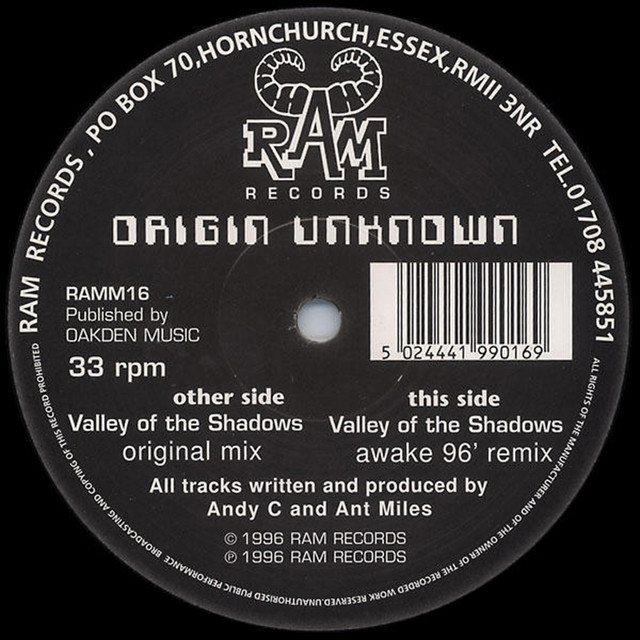
Origin Unknown’s “Valley of the Shadows” belongs to the same breakthrough moment. Its ominous narration and sparse groove showed how suspense could become a dancefloor hook. Be careful with streaming dates: an easily found Spotify edition is dated 1996, while the landmark original is associated with 1993.
Listen · Origin Unknown — Valley of the Shadows
Original recording associated with 1993; linked streaming single is dated 1996.
Moving Shadow, RAM and the emerging independent label network did more than sell records. They connected the studio, the pirate station and the rave. V Recordings also began in 1993, helping create a route for Bristol and wider UK sounds to circulate.
Listen for
Not just faster drums: listen for the contrast between fluid musical ideas and unpredictable, chopped percussion. That tension becomes one of jungle’s defining signatures.
A scene starts recognising itself
The revolutionary feeling of 1993 was not that people suddenly discovered faster breakbeats. It was that listeners could begin identifying a particular combination of rhythmic ideas, low-end pressure, MC energy and visual language as their own scene. Hardcore did not vanish; the growing separation made room for several futures. What was increasingly called jungle had its own shops, dubplates, specialist raves, pirates and a common repertoire of records that could be reconstructed from tape packs.
From the dubplate to the anthem
Origin Unknown's Valley of the Shadows is essential not because a single track defined the whole scene but because it gave DJs an instantly recognisable dramatic structure: spoken fragments, a menacing atmosphere, a rolling low end and enormous contrast between empty space and forceful breaks. Its relationship to RAM Records also foreshadows the importance of artist-led labels. The catalogue number, the white label and the rare acetate mattered socially. A tune could become famous before a conventional music-business launch.
In that environment Andy C and Ant Miles, the Origin Unknown partnership, demonstrate how DJ and studio cultures fed one another. What sounded devastating on a large system was likely to be revised, cut again and distributed through people who understood the floor. The technique was iterative: play it, watch the reaction, change the record.
Promoters become part of the sound
Telepathy, Roast, AWOL, World Dance and the developing Jungle Fever circuit are names to research alongside artists. A flyer records more than marketing. It shows who shared a bill, the terms a promoter used to describe the music, which cities could support an event and which MCs were important enough to list prominently. Early promoters and crews created the spaces where new labels could test whether their music made sense. The promoter's job was unusually musical: selecting a lineup was a way of programming a new genre.
Raves were also unevenly documented. We can sometimes verify an event from a surviving flyer but not what every DJ played or how the crowd responded. Avoid inventing the supposedly legendary "moment" when a tune dropped unless a recording or credible firsthand testimony supports it.
The politics of a name
Various histories credit different sources for the term jungle, including the Danny Jungle story associated with Rage, Jamaican vocal language and broader Black British expressions. These accounts should remain in conversation. The label could be an enthusiastic self-description for some participants and a word others encountered through sensational press coverage. Its later replacement by drum & bass was therefore not merely a technical genre correction.
An additional complexity is that contemporary music journalists sometimes used words from outside the community. A historian should note the difference between language chosen by musicians, labels or promoters and categories assigned after the fact by stores or streaming services.
Sound-system culture inside the music
Ragga-inflected vocal snippets and basslines made the link to Jamaican traditions obvious, but the deeper continuity lay in performance. MCs were not ornamental: they managed pacing, made local and crew identities audible and helped audiences understand unfamiliar rhythms. On radio they could be broadcasters, hosts, tastemakers and community organisers. On a rave tape they made an otherwise anonymous sequence of white labels feel like a specific night and place.
Behind the sound were people handling vinyl distribution, mastering, pirate transmissions and tape duplication. It is worth treating them as historical actors even where their names cannot responsibly be attached to individual events. A jungle track without its distribution circuit would have been a studio experiment. In 1993 that circuit had become a culture with its own expectations.
Evidence note: take a modern compilation titled Jungle Classics 1993 as an invitation to investigate, not a dating authority. The original press, period flyer, DJ set or label archive carries more weight.
Dates in this article refer to original scene activity/releases unless otherwise specified. Streaming platforms may show a later remaster, reissue, upload or regional date. The embedded players belong to their respective rights-holders; DROP THE BASS does not host the recordings.
Releases of 1993
41 jungle and drum & bass releases from 1993 that live in our catalogue.