Ragga voices, pirate-radio energy and records that carried jungle into the charts.
4 min read 3 players
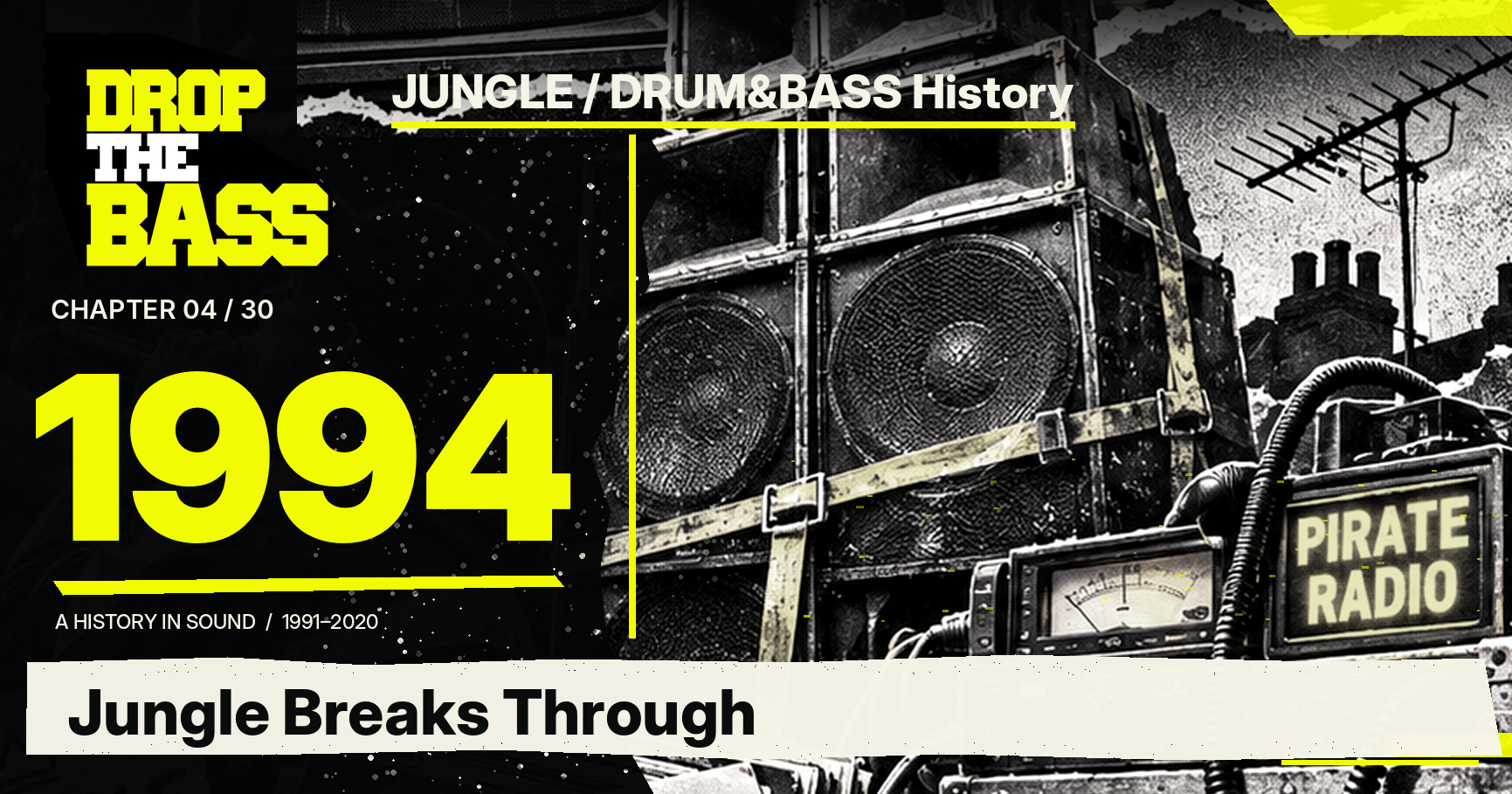
Illustrative collage by DROP THE BASS — not archival photography.
In 1994 jungle stopped being an underground code that only dedicated ravers could decode. The sound of the pirate stations crossed into the national charts, often without losing its bass-heavy character. It was a breakthrough, but it also started a conversation about who controlled jungle’s public image.
The voices of the moment
Shy FX and UK Apachi’s “Original Nuttah” transformed dancehall vocal intensity into a jungle anthem. Rather than treating the reggae connection as a sample library, it placed the MC and sound-system energy in the foreground.
Listen · Shy FX & UK Apachi — Original Nuttah
Original 1994 streaming single, not the later anniversary remake.
M-Beat featuring General Levy — “Incredible” made the leap into the UK Top 10 in its 1994 reissue cycle. Here is the real historical contrast: bass-music language that evolved on pirate radio being performed on BBC television. The upload below comes from the rights-holder and describes the original 15 June 1994 Top of the Pops broadcast.
Watch · M-Beat & General Levy — Incredible (Top of the Pops, 1994)
Official Jet Star Music archive of a June 1994 BBC performance.
YouTube
M-Beat & General Levy — Incredible (Top of the Pops, 1994)
Away from the charts, records such as Renegade’s “Terrorist” and LTJ Bukem’s “Horizons” captured different futures for the music: one ruthlessly direct, the other spacious and atmospheric. Jungle could now mean several linked styles without settling on one formula.
The bigger story
The scene’s Black British and Caribbean roots were essential, even as mainstream coverage increasingly reduced the music to a sensation or a problem. The distinction matters when telling this history through the people who made it, not just its best-selling singles.
From underground language to national conversation
In 1994 jungle became impossible for the British music industry to ignore. It did not stop being underground: pirate stations, small labels, sound-system culture and specialist raves still did most of the work. But the genre now reached a scale at which a hit could be recognised outside the scene, a television performance could introduce an MC to millions, and the press could argue about the music's identity. Visibility brought opportunities and friction together.
Two anthems, two ways of hearing jungle
Shy FX and UK Apache's Original Nuttah announced a confrontational and instantly recognisable ragga-jungle style. M-Beat and General Levy's Incredible brought a different kind of crossover, reaching the UK Top 10 and appearing on Top of the Pops. It is misleading to treat these tracks as interchangeable versions of commercial jungle. One could work as a scene-defining pressure point on a rave system; the other demonstrated that the vocal intensity and rhythmic pace of jungle could survive radio and television exposure.
General Levy's highly visible success also produced arguments about who should speak for the movement. Commercial press coverage sometimes reduced collective work to one newly visible face. The useful historical subject is not a simple villain-or-hero verdict, but the tension between independent crews, musicians seeking recognition, MC culture and a media industry eager to package an unruly scene. Where claims about specific disputes diverge, present the competing accounts and refer to contemporary coverage rather than declare a definitive private conversation.
Kool FM and the theatre of the pirate broadcast
Kool FM and other London stations built recurring audiences before any chart placement. A pirate broadcast was more than the day's playlist. The MC might announce local events, send shouts to listeners and help a new white label build an identity. Tapes copied from those broadcasts reached people who had never attended a London night. The practical consequences were enormous: a selector could test a record, a small label could create demand and a rave could advertise directly to its likely audience.
DJs such as DJ Ron, Brockie, Hype, Randall, Kenny Ken, Micky Finn and DJ Rap operated in a network of live shows, broadcasts and commercial records. Their importance is not reducible to the number of releases under their own names. Mixing and selection were compositional acts in a culture where a five-minute track might occupy only one passage of a much longer narrative.
Metalheadz takes shape
Goldie, Kemistry and Storm helped establish Metalheadz in 1994, a label that would become a reference point for creative intensity rather than one narrowly defined sound. Its early aesthetic was built on ambition and contrast: physical pressure, musical atmosphere and sophisticated editing. Kemistry and Storm were not just figures photographed beside Goldie; they were DJs, organisers and curators whose judgement shaped a catalogue and the community around it.
This is also where a broader story becomes visible: women participated in jungle as selectors, promoters, vocalists and writers despite later historical summaries often treating the scene as a procession of male studio geniuses. Reconstructing their contributions requires attention to flyers, radio lineups, label credits and interviews.
The rave circuit and its image
A jungle night could be a local basement, a dedicated club event or a massive all-night production. AWOL and One Nation show how event brands could become part of a listener's identity. Flyers used extraordinary lettering, futuristic images and bold promises; recordings preserved the MCs and crowd response that made the night recognisable. For editors, the temptation is to fill the page with an attractive flyer and call it evidence. A flyer proves billing and advertising, not attendance or the exact outcome of an event.
The meaning of 1994: jungle could now be a television hit, a pirate-radio ritual, a dubplate art and a crowded rave all at once. Those sometimes contradictory meanings made the next year's expansion possible.
Dates in this article refer to original scene activity/releases unless otherwise specified. Streaming platforms may show a later remaster, reissue, upload or regional date. The embedded players belong to their respective rights-holders; DROP THE BASS does not host the recordings.
Releases of 1994
48 jungle and drum & bass releases from 1994 that live in our catalogue.