2020: The Dancefloor Goes Quiet, the Music Does Not
Lockdowns halt live events, but artists answer with new albums, collaborations and remote discovery.
5 min read 4 players
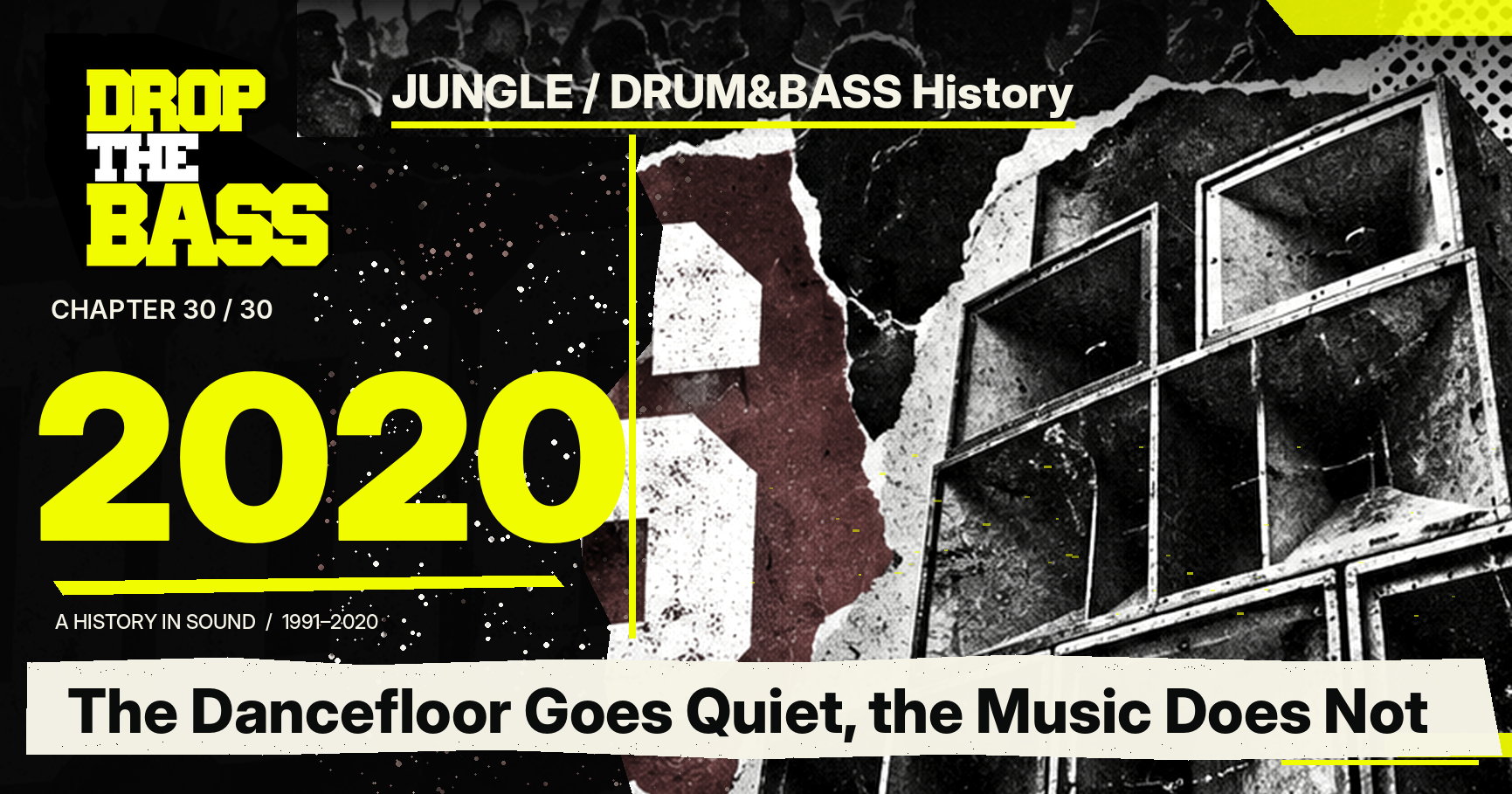
Illustrative collage by DROP THE BASS — not archival photography.
In 2020, the physical spaces that sustained drum & bass abruptly became inaccessible across much of the world. Festivals, tours and local nights stopped or were postponed. Yet the records did not stop coming. Streaming, home listening and remote communities became even more central to the scene's survival.
Deep music for an uncertain room
Alix Perez's Without End, released on his 1985 Music imprint, found space for subdued melodies and soulful voices at a time when the dancefloor was absent. The mini-album is a reminder that drum & bass can fill a room without a crowd. It belongs to a long lineage running from the earliest atmospheric experiments through the liquid and autonomic eras.
Netsky's Second Nature arrived in October, reconnecting the Belgian producer with an uplifting D&B sound while also including guests and cross-genre moments. Its optimistic momentum felt striking against the year's uncertainty. Not all drum & bass produced in lockdown sounded introspective.
Listen · Netsky — Second Nature
2020 digital album; regional Spotify editions may use different IDs.
Pendulum released 'Nothing For Free' in September 2020, one of the band's first new tracks in years, with an animated video that gained an unintended extra resonance during the pandemic. In October Camo & Krooked and Mefjus released 'No Tomorrow' with Sophie Lindinger, blending emotionally charged vocals with intricately designed drum & bass.
There was no normal final rave to close this decade. Instead, the scene carried on through records, streams and online connections, waiting for clubs to reopen. The story that began in 1991 with an emerging breakbeat language had become global enough to survive a year without its usual rooms.
The dancefloor disappears from ordinary life
The COVID-19 pandemic disrupted clubs, festivals, tours and the informal gatherings that make a dance scene work. For drum & bass, which had been built around the sound system and the shared response to a record, this was more than a scheduling problem. It interrupted a central way in which music was developed and understood. Producers could still finish tracks, labels could still distribute releases, and fans could still listen—but the feedback loop between room, DJ and audience was suddenly much harder to reproduce.
A new job for livestreams
DJs, labels and event brands turned toward home-recorded performances, streams and recorded mixes. Some broadcasts were polished, others improvised, and many reminded listeners how important the MC, the crowd and the sound system had been to a normal night. The stream expanded access for international fans while making the absence of collective physical bass painfully obvious.
Shogun's later history describes the Shogun Sessions format as emerging from lockdown-era streams. Such projects are useful evidence of how a label could become a broadcaster and community organiser when normal events stopped. They also raised questions about artist income, licensing, donations and the long-term value of an event recording after the live moment had passed.
Pendulum return to release music
Pendulum returned with Driver and Nothing for Free in September 2020, their first new material in roughly a decade. The significance is partly musical and partly generational: an act associated with D&B's 2000s expansion re-entered a scene transformed by streaming, festivals and numerous younger producers. Their return invited comparisons with the earlier live-band and crossover ambitions that had made Hold Your Colour such a divisive landmark.
Different albums for different rooms—or no room at all
Netsky, Alix Perez and other artists continued releasing music while touring plans and performance opportunities were disrupted. Listeners experienced new recordings in apartments, on headphones and through online communities. Deep and reflective work could take on a different emotional function when the usual social outlet disappeared; hard club music could become a reminder of a shared space people could not visit.
The year also exposed inequalities in the music industry. Artists who relied on live fees faced a different problem from those with another income stream. Small venues, sound engineers, photographers, local promoters, bar staff and security workers lost work alongside DJs. A history focused only on released tracks would miss the people who kept the culture functioning in normal times.
The archive suddenly matters more
Fans revisited old sets, labels reactivated past catalogues and online communities became temporary meeting points. That created opportunities for rediscovery, including for jungle's earlier generations. But this was not a neat triumph of digital technology: listening together over a livestream could not replace the social and physical experience of standing before a powerful system.
Thirty years after the beginning
By the end of 2020 drum & bass had survived several technological and cultural transformations: pirate FM, dubplates, the CD mix, the internet forum, the digital download, YouTube, streaming and online live performance. Its recurrent pattern was adaptability without complete amnesia. The Amen break and sound-system bass remained audible even as audiences, studio practices and distribution changed beyond recognition. The story that started in 1991 does not end here; 2020 is simply the close of one chapter and the beginning of a changed decade.
The missing people in the pandemic photograph
An empty dancefloor makes a powerful image, but it omits the people whose work normally fills a venue: sound technicians, lighting crews, photographers, ticketing staff, cleaners, security workers, bar staff, drivers and promoters handling contracts and cash flow. Most do not have royalties or extensive online catalogues to support them through cancelled shows. Their vulnerability is part of the story of 2020, not a peripheral economic footnote.
The crisis altered the act of listening as well. Jungle culture had always included broadcasts heard alone at home; what disappeared was the possibility of meeting the same community at a club or rave afterward. A livestream could bring geographically scattered listeners into a chat, but it could not reproduce a wall of sub-bass and the social exchanges surrounding a live set. This difference helps explain why the return of physical events would matter beyond the return of any particular headline act.
Historical dates refer to the original event or release, not necessarily the later upload or digital edition visible in a player. Media is embedded from rights-holders or existing platform hosts; DROP THE BASS does not host these recordings.
Releases of 2020
3,468 jungle and drum & bass releases from 2020 that live in our catalogue.